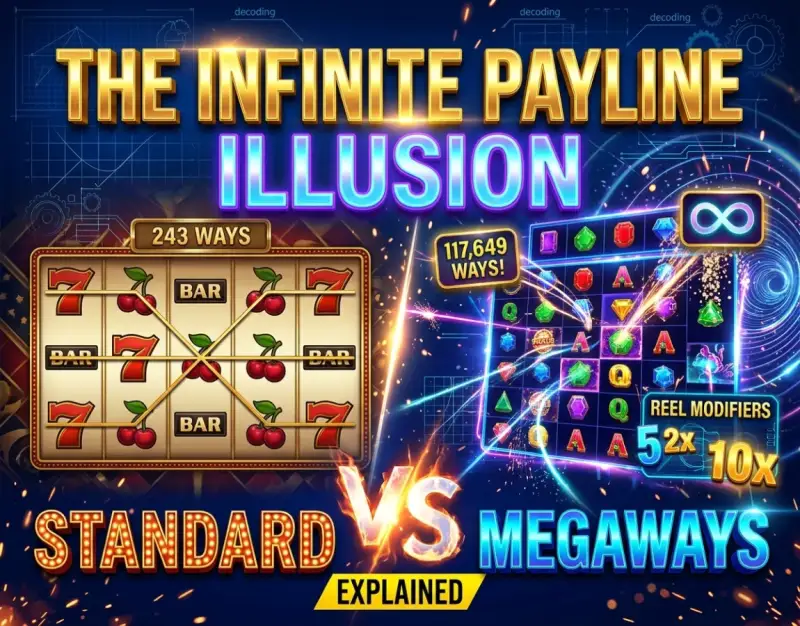
For decades, the architectural DNA of slot gaming remained tethered to the ghosts of its physical past. Players pulled virtual levers, watching rigid rows of mechanical symbols align across three, five, or occasionally nine static paylines. The math was transparent, predictable, and fundamentally linear. However, the contemporary digital landscape has been thoroughly upended by a computational revolution. Software studios, driven by player demand for visceral volatility and staggering win potential, have discarded fixed paylines in favor of dynamic grid architectures. At the forefront of this transformation is the phenomenon of dynamic reel modifiers, which completely alter how we calculate probability and risk.
Yet, behind the blinding flashing lights of modern games lies a profound psychological and mathematical paradox. The industry often markets these innovations as "infinite paylines," a seductive phrase that promises boundless wealth with every single spin. As an investigative journalist who has spent years dissecting the underlying source code and Return to Player (RTP) models of top-tier software providers, I can tell you that this marketing framing is a masterclass in illusion. Understanding the structural chasm between traditional fixed-payline setups and dynamic mechanics requires looking past the surface-level visual noise to examine the brutal, beautiful reality of modern slot math.
This comprehensive guide—designed to serve as the definitive manual on megaways slots and traditional frameworks—will deconstruct the underlying engineering of these games. Whether you are an analytical hobbyist or an advanced advantage player seeking to optimize your bankroll management, decoding these engines is critical. We will examine how dynamic symbol sizing works, why the illusion of infinite paths to victory can warp risk perception, and how you can approach these games with eyes wide open, sidestepping the hidden financial traps embedded within high-variance digital math models.
Foundational Principles: Decoding the Slot Math Engine
To truly comprehend the mechanics governing modern casino floors, one must first master the vocabulary of probability that dictates every spin of the reels. At its most basic level, a slot machine is a closed-loop probability engine governed by a pseudorandom number generator (RNG). Every outcome is entirely independent, determined the microsecond you press the spin button. Historically, developers programmed this RNG to populate a fixed grid where paylines were hardcoded into the software. A payline was simply a designated geometric path—straight, diagonal, or zigzagging—that connected matching symbols from the leftmost reel to the rightmost.
Standard ways-to-win systems, such as the classic 243-ways or 720-ways formats, eliminated the need for rigid lines. Instead, they required matching symbols to land on adjacent reels, regardless of their vertical position. This innovation exponentially increased the number of potential winning combinations per spin without altering the physical dimensions of the grid. If a three-row, five-reel machine offered 243 ways, it simply meant multiplying the number of symbols on each reel together ($3 \times 3 \times 3 \times 3 \times 3 = 243$). It was a clean, mathematically deterministic system that laid the groundwork for the structural explosion that followed.
The paradigm shift occurred when developers realized that the reels themselves did not need to remain static. By introducing variable symbol heights per reel on every spin, the total number of active symbols could fluctuate wildly from one round to the next. If Reel 1 could display anywhere from two to seven symbols, and the remaining reels could do the same, the mathematical permutations exploded into the tens or hundreds of thousands. This variable-grid framework birthed the industry-dominating format that changed modern gambling forever, creating an entirely new paradigm of high-volatility entertainment.
Anatomy of the Megaways Revolution
The proprietary mechanic that popularized variable-reel architecture transformed the iGaming industry almost overnight, proving that players craved dynamic unpredictability. In a standard Megaways configuration, the grid consists of six primary reels, often accompanied by an auxiliary horizontal tracker reel at the top or bottom. On any given spin, the RNG dictates how many symbols will land on each of the six reels—typically ranging from a minimum of two to a maximum of seven.
When all six reels expand to their maximum capacity of seven symbols each, the mathematical permutation engine calculates the maximum possible winning combinations: $7 \times 7 \times 7 \times 7 \times 7 \times 7 = 117,649$ ways to win. Some modern iterations push this even further through cascading reels and expanded trackers, occasionally boasting hundreds of thousands or even millions of theoretical ways. This constant state of flux means that no two spins are mathematically identical, keeping the player’s cognitive engagement at a continuous peak as they scan the shifting landscape for potential connections.
However, this mechanical fluidity comes with a hidden structural trade-off. Because the game must account for up to 117,649 ways on a single spin, the individual payout value for matching low-tier symbols must be drastically reduced. If every winning combination paid out at the same rate as a traditional 9-line slot, the game's mathematical model would hemorrhage money within minutes. Consequently, players often experience "false wins"—payouts that are smaller than the initial stake, despite landing a multi-symbol combination across four or five reels. This mathematical reality underscores why understanding the underlying volatility is far more important than staring at the headline-grabbing maximum payline count.
Reel Modifiers and Cascading Dynamics
Beyond fluctuating symbol counts, the magic of modern dynamic slots is heavily propped up by specialized reel modifiers. These software routines inject bursts of extraordinary activity into an otherwise standard spin sequence. Chief among these is the cascading reels mechanic—often referred to as tumbling, avalanches, or reactions. When a winning combination occurs, the participating symbols vanish from the grid, and new symbols drop from above to fill the empty spaces, potentially triggering consecutive wins from a single paid spin.
Cascades transform the baseline volatility profile of a game. They create psychological momentum, allowing a modest initial investment to snowball into an extended sequence of payouts. When paired with progressive multipliers that increase with each consecutive cascade, the win potential scales exponentially. To see how these complex features are conceptualized and built from the ground up, you can examine our deep dive into Anatomy of a Mega Hit: Inside the Studio Designing Next-Gen Branded Slots, which explores the intricate studio design philosophies driving modern slot development.
Other popular reel modifiers include mystery symbols that transform into matching icons after the reels stop, expanding wilds that cover entire columns, and split symbols that double the count on a specific reel. Each modifier acts as a catalyst, shifting the mathematical weight of the session. While standard ways games rely on steady, incremental returns, modifier-heavy engines concentrate their RTP into explosive, high-variance clusters, making bankroll preservation a mandatory skill for anyone sitting down at the machine.
Comparing the Math: Megaways vs. Fixed Ways
To evaluate these systems objectively, we must look past the flashy marketing and analyze the raw metrics: RTP, Hit Frequency, and Volatility Distribution. Traditional fixed-payline slots and static ways-to-win games typically offer a predictable distribution of returns. Their hit frequency—the percentage of spins that result in any payout—is often relatively high, frequently hovering between 20% and 30%. This means roughly one in every three or four spins yields a return, keeping the player's session buoyant over a sustained period.
Megaways slots and infinite-ways games often invert this paradigm. Because a massive portion of the game’s RTP is locked away inside the volatile free spins bonus round or massive cascading multiplier chains, the base game hit frequency can drop significantly, sometimes falling below 20%. Players frequently encounter long dry spells punctuated by sudden, dramatic spikes in value. This is not a flaw in the programming; it is an intentional mathematical design choice aimed at delivering the extreme win multipliers—often exceeding 10,000x stake—that modern players actively seek.
| Feature / Metric | Standard Fixed Paylines | Traditional Ways (e.g., 243 Ways) | Megaways / Infinite Paylines |
|---|---|---|---|
| Grid Structure | Static rows and fixed lines | Static rows, adjacent reel matching | Dynamic, variable symbol heights per reel |
| Max Win Paths | 10 to 50 lines typically | 243 to 1,024 ways | 117,649 to hundreds of thousands |
| Base Game Hit Frequency | Moderate to High (25% - 35%) | Moderate (22% - 28%) | Low to Moderate (18% - 24%) |
| Volatility Profile | Low to Medium | Medium | High to Extreme |
| Primary RTP Source | Evenly distributed across base game | Balanced base and minor bonus features | Concentrated in bonus rounds and multipliers |
The Psychology of the Infinite Payline Illusion
The term "infinite paylines" is a brilliant piece of marketing semantics. Mathematically speaking, paylines do not exist in a true Megaways slot; instead, the game calculates adjacent symbol combinations from left to right. Yet, calling them "dynamic ways-to-win engines" lacks the psychological punch of "Megaways." Human beings are naturally drawn to scale and abundance. The visual spectacle of 117,649 potential winning combinations triggers a cognitive bias known as the illusion of control and the near-miss effect.
When a player sees a massive grid pulsing with thousands of ways, their brain registers that every single symbol on the screen represents a potential win vector. However, as noted earlier, high ways counts correlate directly with deflated individual symbol payouts. A player might land a win across 5,000 different ways simultaneously, only to watch their total credit balance drop because the payout multiplier for that specific symbol was fractions of a coin. This phenomenon creates a psychological cushion where small losses feel like victories because of the sheer visual noise accompanying the win.
Furthermore, this dynamic interacts directly with the temptation of fast-tracking features. When players face brutal base game dry spells driven by extreme mathematical variance, the psychological urge to bypass the grind becomes overwhelming. Understanding how these shortcuts impact your overall expected return is crucial for long-term survival, as detailed in our analysis of Bonus Buy Traps: Calculating the True Cost of Skipping the Grind.
Strategic Bankroll Management for High-Variance Engines
Given that dynamic mechanical slots are engineered for high volatility, approaching them with a traditional flat-betting strategy designed for classic fruit machines is financial suicide. If a game allocates 60% of its total return to a volatile free spins feature that might only trigger once every 350 spins on average, your bankroll must be deep enough to weather those extended statistical valleys.
Professional advantage players and disciplined gamblers utilize specific bankroll allocation rules when tackling dynamic reels:
- Session Bankroll Sizing: Ensure your total session bankroll equals a minimum of 200 to 300 times your intended base stake. If you are playing at $1.00 per spin, your session allocation should safely absorb a $300 drawdown without triggering emotional decision-making.
- Stake Scalping: Scale your bet size relative to your total bankroll rather than chasing losses. Dropping your stake during cold streaks preserves your staying power, allowing you to remain in the game until the RNG cycles into a favorable distribution.
- Feature Cost Awareness: If the game offers optional features or accelerated buy-ins, calculate the exact percentage of your bankroll being risked on a single event. Never commit more than 2% to 5% of your total bankroll to a single high-variance bonus purchase.
Critical Mistakes and How to Avoid Them
Navigating the complex math of modern slots requires avoiding several classic pitfalls that trap inexperienced players:
1. Chasing the Maximum Win Potential
Many players fixate on the advertised 20,000x or 50,000x maximum win plastered across the promotional banner. They assume that because the math model supports such a payout, it is an achievable milestone during a standard session. In reality, maximum win caps are lottery-ticket events with astronomical odds—often 1 in 100 million spins or worse. Treat max wins as a statistical novelty rather than an expected outcome.
2. Ignoring RTP Discrepancies Across Casinos
A staggering number of modern software providers offer configurable RTP ranges. The exact same game might run at a 96.5% RTP on one platform and a dismal 90.5% on another. Always check the game information panel before committing funds to ensure you are playing the highest available math version.
3. Misinterpreting Win Size via Cascades
As discussed, cascading wins can create deceptive feedback loops. A spin that costs $2.00 might result in four consecutive cascades, ultimately returning $1.50. The player feels a rush of excitement from the multi-stage action, ignoring the fact that they just lost 25% of their stake on that round. Focus on net session delta, not visual flashiness.
4. Failing to Account for Hit Frequency Drops
Transitioning from a classic 9-line slot to a 117,649-ways monster without adjusting your expectations will lead to frustration. Expect longer streaks of dead spins and size your wagers downward to compensate for the altered hit frequency.
5. Over-Relying on Bonus Buys
Skipping the base game via direct purchases alters the RTP structure and dramatically increases session volatility. Treat these features as extreme luxury purchases rather than standard tactical plays.
Frequently Asked Questions
What is the actual difference between paylines and ways-to-win?
Traditional paylines require symbols to land on exact, predetermined geometric patterns spanning the reels. Ways-to-win mechanics—and by extension, dynamic systems—eliminate lines entirely, requiring matching symbols to appear anywhere on adjacent reels starting from the leftmost side. This exponentially increases the number of winning combinations without requiring complex line mapping.
Are Megaways slots rigged to drain money faster?
No. Like all modern regulated digital slots, Megaways games are governed by certified random number generators and audited RTP percentages. They are not "rigged," but their mathematical volatility is intentionally configured to be much higher than traditional slots. This means money can fluctuate and deplete much faster during dry spells, balanced by the potential for massive, explosive wins.
Why do some wins pay less than my total bet on a Megaways game?
This occurs due to the fundamental mathematics of high-ways systems. Because the game must account for tens of thousands of potential winning paths, the individual payout multiplier for matching low-tier symbols is scaled down significantly. Landing a win across numerous ways simultaneously can still result in a net payout that is less than your initial stake.
Can I use a betting system like Martingale on dynamic reel slots?
Using progressive betting systems like Martingale on high-volatility slots is extraordinarily dangerous. Because dynamic reel games feature extended dry spells and unpredictable variance curves, doubling your bet after every loss will quickly exhaust even a substantial bankroll long before the math model corrects itself.
How do I find the true RTP of a specific slot machine?
The most reliable method is to open the game's official rules, help file, or paytable menu within the software client itself. Regulated operators are required to display the exact RTP version currently active on that specific server instance. Always verify this number before playing.
Strategic Roadmap and Final Takeaway
The evolution from static mechanical fruit machines to dynamic, infinite-ways digital engines represents a monumental leap in game design and mathematical engineering. While the marketing terminology of "infinite paylines" is undeniably an illusion, the underlying computational architecture has permanently redefined what players expect from an online slot session. These games deliver unmatched levels of engagement, visceral volatility, and cinematic audiovisual immersion that their mechanical ancestors could never dream of achieving.
As we look ahead to the next two to five years, expect software studios to push these mechanics even further through immersive virtual reality integration, customizable volatility matrices, and cross-game persistent progression systems. However, as the technology grows more complex, the foundational rules of smart gambling remain entirely unchanged. True mastery of modern slot mechanics does not come from chasing illusions of infinite wealth; it comes from rigorous bankroll discipline, a deep understanding of mathematical variance, and an unwavering commitment to playing informed.
Be the first to share a gentle reflection on this story.