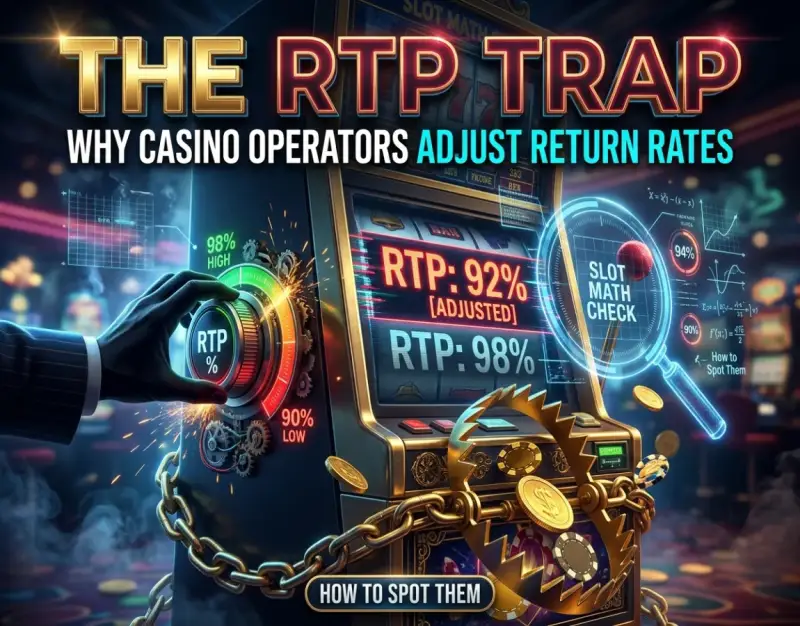
Walk into any online casino today, load up your favorite video slot, and you are participating in a multi-billion-dollar psychological and mathematical experiment. For decades, players operated under a comforting assumption: a slot machine's Return to Player (RTP) percentage—say, 96.5%—was an immutable factory setting, branded into the code by developers like NetEnt, Pragmatic Play, or Play'n GO, much like the physical gears of a classic mechanical one-armed bandit. You assumed that whether you spun the reels in Malta, London, or New Jersey, the mathematical expectation of your return remained steadfastly identical.
That comforting illusion has been systematically dismantled by modern iGaming economics. Today, major game studios build multiple RTP profiles into a single title, handing operators the digital keys to adjust payout percentages downward at will. This industry-wide shift toward The Ultimate Volatility Matrix: Matching Your Personality to the Right Slot has transformed slot selection from a game of casual preference into a high-stakes investigation of operator math. When a casino can quietly swap out a 96% configuration for a punishing 88% version overnight, the casual player’s bankroll becomes dangerously exposed to hidden house edges.
This comprehensive guide exposes the mechanics of adjustable RTP, examines why casino operators manipulate these configurations, and arms you with the investigative tools necessary to perform a rigorous slot math check. By understanding how these systems operate, you will shift from an unwitting target of predatory math configurations to an empowered player capable of finding best RTP slots across any modern online lobby.
Understanding the Architecture of Modern Slot Math
The Definition and Illusion of RTP
Return to Player (RTP) is a theoretical statistical calculation representing the percentage of all wagered money a slot machine will pay back to players over millions of spins. It is critical to understand that RTP is not a short-term guarantee; it is a long-term mathematical equilibrium governed by a Pseudo-Random Number Generator (PRNG). If a game features a 96% RTP, it means that theoretically, for every $100 wagered across the global player base over infinite iterations, $94 is returned in winnings while $6 remains as house profit.
However, players frequently misinterpret this metric as a personal session predictor, leading to severe disappointment when a high-RTP session results in a total bankroll wipeout. This variance is heavily influenced by mechanics explored further in discussions surrounding The Dark Side of Bonus Rounds: Why Dead Spins Outnumber Big Wins, where volatility dictates how those returns are distributed. When operators introduce customizable RTP profiles, this already complex mathematical environment becomes a moving target.
How Multi-Configuration Math Works
Historically, game developers distributed a single executable file for a slot title containing fixed paytables and fixed return rates. As regulatory bodies opened up multi-jurisdictional licensing and competitive pressures mounted, software providers changed their approach. Studios now engineer games with modular math models. A single modern slot title may be shipped with up to five distinct RTP profiles—for example, 96.5%, 94.5%, 92.5%, and 88.5%.
Behind the scenes, these profiles alter the underlying paytable values, hit frequencies, or weighted reel strips. While the audiovisual presentation, animations, and bonus triggers remain completely identical, the mathematical probability of landing high-value symbol combinations is quietly dialed down in lower profiles. The operator simply logs into their casino management platform, selects the desired configuration from a drop-down menu for a specific software provider, and deploys it to the site.
The Regulatory Landscape and Licensing Loopholes
Regulation is often viewed by consumers as an impenetrable shield, but in the realm of adjustable RTP, regulatory frameworks vary wildly across global jurisdictions. Strict Tier-1 regulators, such as the UK Gambling Commission (UKGC) or the Malta Gaming Authority (MGA), enforce strict transparency rules. Operators licensed in these jurisdictions must prominently display the active RTP of every game within the help files or paytable information screens.
Conversely, offshore jurisdictions, white-label aggregators, and loosely regulated licensing bodies often permit operators to obscure or omit this information entirely. This regulatory fragmentation creates a Wild West environment where operators can quietly downgrade their Arcade Meets Casino: Skill-Based Elements Hitting Modern Slot Machines configurations to offset rising affiliate costs, platform fees, and tax burdens without ever alerting the consumer.
Why Casino Operators Adjust Return Rates
Mitigating Operating Costs and Bonuses
Operating a profitable online casino in the modern digital economy requires navigating punishing overheads. From hefty payment processing fees and platform licensing costs to aggressive affiliate marketing commissions and lucrative welcome bonus structures, profit margins are under constant siege. When a casino awards a 100% match bonus coupled with 200 free spins, they are absorbing substantial financial liability.
To offset these acquisition costs and protect their bottom line, operators routinely route bonus play or general traffic toward lower RTP configurations. By shaving 3% to 6% off the theoretical return of popular slots, the casino mathematically accelerates the house edge, recouping promotional expenditures much faster than they would under standard, unadjusted math profiles.
Managing Volatility and Liquidity Risks
Beyond daily operational overheads, operators must manage liquidity risks associated with progressive jackpots, high-roller action, and massive volatility spikes. If a network progressive jackpot drops on an operator’s platform, or if a cluster of VIP players hits maximum win multipliers on high-volatility slots, the operator's immediate cash flow takes a massive hit.
Adjustable RTP acts as an internal financial shock absorber. By shifting games to lower return profiles during peak promotional periods or across specific player segments, operators smooth out their revenue curves, ensuring that sudden liability spikes do not threaten the financial stability of the business.
The Economics of Market Segmentation
Not all online casino markets are created equal. In highly competitive, regulated markets where player sophistication is high, operators are often forced to run games at their highest factory-default RTP configurations to remain attractive. However, in emerging markets, grey markets, or jurisdictions with low consumer awareness, operators can quietly dial down return rates without experiencing customer churn.
This market segmentation allows multi-brand casino groups to maximize yield extraction from less discerning consumer bases while maintaining competitive facades in stricter regulatory territories. The player sitting in a jurisdiction with lax consumer protection laws pays a hidden "tax" in the form of suppressed RTP values.
The Anatomy of a Slot Math Check
Inspecting In-Game Help Files and Paytables
The first and most direct line of defense in identifying casino RTP ranges is conducting a manual inspection of the game's official help files, rules page, or paytable. When you load a slot machine, resist the urge to spin immediately. Instead, click the menu, info, or question mark icon and scroll past the symbol values to the legal and statistical fine print.
Legitimate, transparent operators will explicitly state the active RTP percentage for that specific game instance. If the documentation lists a range—such as "RTP: 92.0% - 96.5%"—or fails to state the figure entirely, you are looking at a system capable of dynamic adjustment. Always record or screenshot these figures before committing real money to your balance.
Comparing Game Versions Across Different Lobbies
A seasoned slot investigator never takes a game's math at face value. One of the most effective methods for spotting suppressed return rates is cross-referencing the exact same slot title across multiple distinct casino brands. Load a popular title, such as Pragmatic Play’s *Gates of Olympus*, on Casino A, and check the help file. Then, load the identical game on Casino B.
You will frequently discover that Casino A runs the title at 96.50%, while Casino B runs it at 94.50% or even 94.00%. This discrepancy proves that the game developer provides multiple math models and that individual operators make active choices regarding which version to host. Spotting these variances allows you to vote with your wallet and patronize platforms that respect player capital.
Leveraging Independent Testing Laboratories
Third-party testing agencies—such as eCOGRA, iTech Labs, BMM Testlabs, and GLI—play a vital role in certifying slot fairness. These laboratories audit the PRNGs and verify that the math models match the developer's specifications. However, certification does not mean all versions of a game have high RTPs; it simply means the chosen version operates honestly according to its programmed parameters.
Savvy players utilize public audit reports published by these testing agencies to cross-verify operator compliance. Many operators feature certification seals in their website footers that link directly to live certificates showing average monthly payout percentages across different game categories. Reviewing these reports provides macro-level insight into whether a casino leans toward player-friendly or house-favorable configurations.
Step-by-Step Methodology for Finding Best RTP Slots
Building an Operator Research Protocol
Finding consistently high-paying slots requires a systematic research protocol rather than blind searching. Begin by compiling a shortlist of online casinos known for transparent operations and commitment to player-friendly math models. Avoid platforms that obscure their terms or operate under anonymous, questionable licensing bodies.
- Audit the Software Providers: Identify casinos that partner with studios known for enforcing strict RTP standards or those that transparently display version numbers in their loading screens.
- Check the Terms and Conditions: Read through the casino’s bonus and general T&Cs to identify clauses regarding game restrictions, restricted RTP configurations, or modified payout percentages during promotional play.
- Test Before Depositing: Open games in demo mode or log out of your account if the casino permits unauthenticated viewing, allowing you to inspect help files without risking capital.
Utilizing Aggregator Databases and Community Forums
No single player can manually check the thousands of slot titles released each year. To scale your investigation, tap into specialized slot aggregator databases, independent review sites, and dedicated player communities. Platforms that specialize in slot math track provider releases and document multi-tier RTP ranges for every major game.
Community forums, such as dedicated Reddit communities and streaming discords, are also invaluable real-time intelligence sources. When operators quietly downgrade a popular game's RTP, community members are often the first to notice, screenshot the discrepancy, and share the findings. Integrating these crowd-sourced alerts into your pre-play routine ensures you stay ahead of predatory operator adjustments.
Maintaining a Personal Session and Data Log
Ultimately, empirical tracking of your own play is the acid test of slot dynamics. While short-term variance will always skew results, maintaining a detailed session log helps you identify anomalies in hit frequencies and bonus triggers. Record the game title, casino platform, starting bankroll, total spins, bonus entry frequency, and session net result.
Over hundreds or thousands of spins across standardized bet sizes, comparing your observed hit patterns against theoretical parameters can reveal whether a game feels unusually suppressed. While not a definitive proof of adjustment due to high volatility, persistent underperformance across multiple sessions on a specific platform warrants a deeper audit of that casino's game versions.
Real-World Case Studies & Scenarios
Case Study 1: The Quiet Downgrade on a Flagship Release
In early 2023, a prominent mid-tier online casino operator launched a major marketing push for a blockbuster slot release from a top-tier studio. The game debuted with massive fanfare, and thousands of players flocked to the platform to test the new mechanics. However, an investigative slot reviewer inspecting the platform's game files discovered a disturbing discrepancy.
While the developer’s default RTP for the title was 96.51%, the version hosted by this specific operator was running on the 94.14% configuration profile. The operator had not notified players of the downgrade; it was buried deep within the game's legal help documentation. Within 48 hours, player forums exposed the discrepancy, leading to a localized PR backlash and a noticeable migration of players to competing transparent brands. The lesson? Always inspect the help file, even on newly released flagship games.
Case Study 2: The Bonus-Specific RTP Trap
A prominent international gaming brand decided to launch a lucrative welcome promotion offering a 200% deposit match. To protect their financial exposure, the operator quietly updated their site terms to restrict bonus wagering to a specific tier of slots—those configured with the lowest available RTP profiles (around 88.00% to 90.00%).
Unsuspecting players eagerly claimed the bonus, believing the extra funds gave them a mathematical edge. In reality, the suppressed RTP combined with standard wagering requirements created an insurmountable house edge that effectively neutralized the bonus value before wagering could be completed. Players who failed to read the fine print lost their entire deposits within hours, illustrating how adjustable RTP and promotional terms intersect to exploit uninformed consumers.
Critical Mistakes and How to Avoid Them
| Mistake | The Underlying Danger | Strategic Countermeasure |
|---|---|---|
| Assuming Universal RTP | Believing a slot's payout is identical across every casino, leading to accidental play on suppressed 88% or 90% configurations. | Always open the game info/help file on every new casino platform to verify the active RTP before spinning. |
| Ignoring Bonus T&Cs | Accepting deposit matches without checking if bonus funds lock you into low-RTP game variants. | Thoroughly read promotional terms for game weighting and restricted list clauses before opting in. |
| Chasing Losses on Adjusted Math | Believing a cold streak will reverse, unaware that a lower RTP profile makes long-term recovery mathematically harder. | Set strict session stop-loss limits and walk away when thresholds are met, regardless of perceived slot behavior. |
| Failing to Cross-Reference | Trusting casino marketing claims without verifying game versions across competing industry lobbies. | Compare game help files across at least two independent casino platforms prior to committing significant bankrolls. |
| Relying Solely on Demo Play | Testing slots exclusively in free-play mode where operators sometimes default to higher, more generous RTP configurations. | Verify that demo mode RTP matches the real-money configuration by checking the live help file while logged into a funded account. |
Mistake 1: Relying on Demo Mode Math Parity
Many players test new slots in free-play or demo mode before depositing real money, assuming the math model is identical. However, some operators and aggregators utilize demo modes configured to the highest factory-default RTP to entice players, only to switch the game to a lower profile once real-money wagers begin.
Countermeasure: Never trust demo mode as proof of real-money configuration. Always verify the active RTP within the real-money game client by checking the help documentation after logging into your funded account.
Mistake 2: Neglecting the Cumulative Impact of Volatility
Players often focus exclusively on the headline RTP figure while ignoring how volatility interacts with adjusted math models. A drop from 96% to 92% RTP does not just shave off a few cents per dollar; it fundamentally alters the distribution of wins, starving the base game of medium-tier payouts and increasing the frequency of extended dead-spin sequences.
Countermeasure: Pair your RTP checks with a thorough analysis of the game's volatility rating and hit frequency, ensuring your bankroll sizing can absorb the harsher mathematical reality of lower configuration profiles.
Frequently Asked Questions
What is adjustable RTP in online slots?
Adjustable RTP refers to a modern game development practice where software providers build multiple return-to-player percentage configurations into a single slot title. This allows casino operators to select and deploy lower or higher payout profiles (e.g., 96%, 94%, or 90%) based on their business needs, regulatory requirements, or operational costs.
Is it legal for casinos to change slot RTPs?
Yes, in many jurisdictions, it is entirely legal for operators to choose from developer-supplied RTP ranges, provided they comply with local regulatory disclosure laws. In strictly regulated markets like the UK, operators must clearly display the active RTP. In less regulated markets, disclosure may not be legally mandated, leaving players vulnerable to hidden reductions.
How can I find out the exact RTP of a slot I am playing?
To find the exact RTP, open the slot machine's menu, settings, or help/info file before placing any real-money wagers. Scroll through the rules and legal text until you locate the return-to-player percentage. If the game does not list a specific number or only displays a broad range, check the casino's terms and conditions or play on a more transparent, audited platform.
Do progressive jackpot slots have adjustable RTP?
Many progressive jackpot slots do feature adjustable base-game RTP configurations. While a fixed percentage of every bet contributes to the progressive pool, the foundational math model governing regular symbol wins can still be adjusted downward by operators, making the base game even more volatile than intended.
Does casino loyalty or VIP status affect game RTP?
Generally speaking, standard game RTP configurations apply universally to all players on a given platform instance. However, certain VIP programs or customized cashback incentives can alter the effective net return by rebating a portion of the house edge back to the player, though the underlying slot math remains untouched.
Strategic Roadmap and Future Outlook
The rise of adjustable RTP models represents a permanent structural evolution in the online gambling industry. As operating costs climb and competition intensifies, casino operators will continue utilizing modular math configurations to protect their profit margins and manage financial risk. For the modern slot player, ignorance of these mechanics is an expensive liability. Navigating the modern iGaming landscape requires a shift in mindset: moving from passive entertainment consumer to vigilant, analytical investigator.
Looking ahead over the next two to five years, industry transparency is expected to face mounting regulatory scrutiny. Consumer advocacy groups and stricter regulatory bodies are likely to push for mandatory, standardized RTP labeling across all global jurisdictions, potentially forcing operators to display active payout percentages directly on game thumbnails in casino lobbies. Until that standard becomes universal, your best defense remains vigilance: always inspect help files, cross-reference game versions across multiple platforms, and patronize operators committed to absolute mathematical transparency.
Be the first to share a gentle reflection on this story.