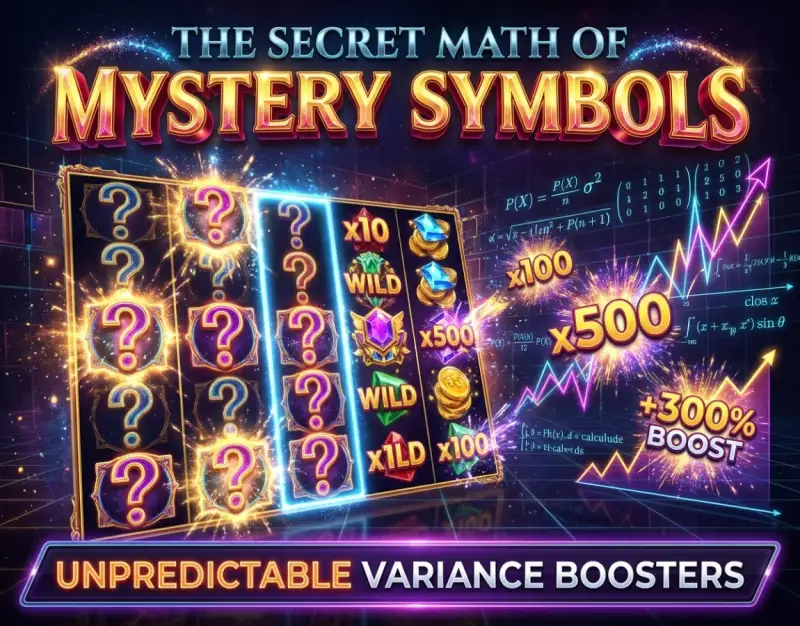
Imagine spinning an online slot where the reels come to a sudden halt, locking several identical, ornate question-mark symbols across the grid. For a split second, the machine falls completely silent, building acute psychological tension. Then, in unison, every single mystery icon bursts open to reveal the exact same high-value premium symbol or a cascade of coins. This electrifying theatrical moment, familiar to anyone tracking the evolution of modern casino games, is no mere cosmetic trick. Beneath the flashy animations lies a rigorously engineered mathematical engine designed to dramatically reshape the volatility profile of the game.
For decades, game designers relied on fixed paylines, static wilds, and predictable scatter triggers to dictate a slot's mathematical temperament. However, the commercial explosion of Megaways and grid-based titles fundamentally shattered this old paradigm. To keep players engaged in an era of hyper-volatile entertainment, developers needed tools that could artificially compress distribution curves—injecting sudden, explosive payout potential into otherwise dry spinning cycles. Thus, transforming reels and advanced stacking features evolved from simple gimmicks into the industry's most potent variance boosters, turning ordinary spins into high-stakes mathematical events.
Understanding the secret math behind these mechanics requires looking past the visual presentation and examining the underlying probability matrices. When a software provider codes a mystery symbol sequence, they are not just rolling a die for a random icon; they are manipulating the distribution of expected returns, altering hit frequencies, and redefining how top-tier jackpots are delivered. Whether you are an analytical player seeking to decode game volatility or an aspiring math modeler, examining The Mathematical Architecture of Modern Slots: From Reels to Server-Based RNG reveals how these dynamic elements interact with the core pseudo-random number generator (PRNG) to create unique risk-reward profiles.
Foundational Principles and Mechanics of Mystery Icons
To master the math of mystery symbols, one must first deconstruct the core terminology and technical mechanics that govern their operation. At its absolute foundational level, a mystery symbol is a placeholder—a neutral game piece that lands on the reels during a base game or bonus round before dynamically morphing into another game symbol. Unlike wild symbols, which actively substitute for missing links in a payline, or scatter symbols, which trigger discrete features, mystery symbols act as collective transformers. They are programmed to read the outcome of a spin and display a single, uniform symbol chosen from a predetermined subset of the game’s paytable.
The implementation of these mechanics relies heavily on two distinct structural sub-types: fixed-position clustering and expanding reel transformations. In fixed-position models, a random number of mystery icons land on specific grid coordinates, opening to reveal either low-tier royals or premium icons. Conversely, expanding or stacking features often see these icons cover entire reels or trigger cascading transformations that propagate across adjacent columns. This creates a psychological and mathematical bridge between standard reel setups and complex grid formations, a dynamic explored further when analyzing how Decoding Cluster Pays: Why Modern Grid Slots Demand a Total Bankroll Rewrite alters short-term variance management and player exposure.
Furthermore, the structural integration of these symbols directly impacts a game's Return to Player (RTP) allocation. Math models must account for the fact that a single screen filled with mystery symbols can either yield a devastating dead spin (if they reveal low-paying card ranks on
Be the first to share a gentle reflection on this story.