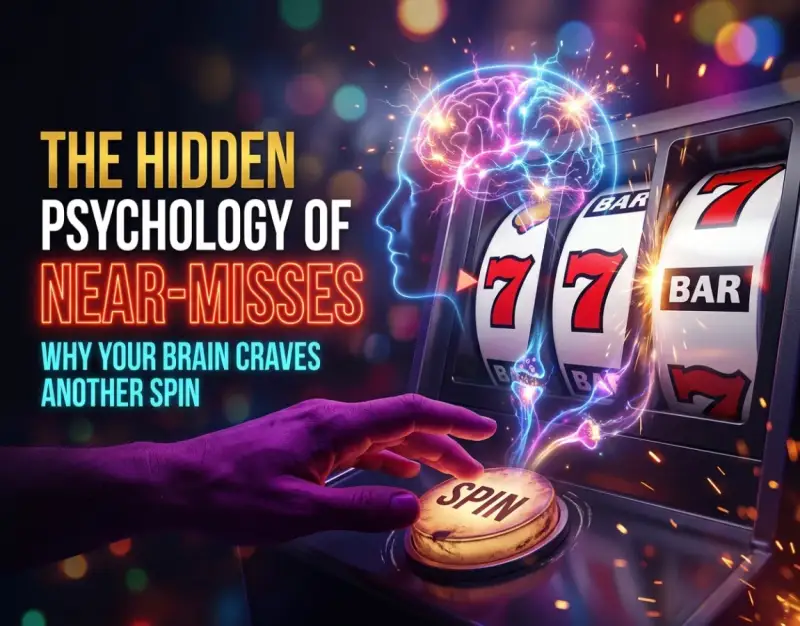
Picture this classic casino scene: you press the spin button on a modern digital slot machine. Reel one lands on a glittering jackpot scatter symbol. Reel two lands on the matching symbol with a resounding audio thump. Reel three spins rapidly, slowing down right above the final scatter symbol, resting just one millimeter off the payline. Your heart leaps into your throat, a surge of adrenaline hits your bloodstream, and an overwhelming internal command echoes through your mind: “I was so close! The next spin is definitely going to hit.”
That electrifying sensation is not a coincidence, nor is it evidence of an impending payout. It is the result of decades of refined behavioral psychology, neurobiology, and mathematical engineering working in perfect synchronization. Known in academic literature as the "near-miss effect," this phenomenon represents one of the most potent cognitive catalysts in modern gambling architecture. In an era where digital slots have migrated from simple mechanical reels to complex, cloud-hosted algorithms, understanding how your brain interprets failure as pseudo-success is no longer just interesting trivia—it is the foundational boundary between intentional entertainment and financial depletion.
Over the last twenty years, the slot machine industry has undergone a radical shift. The mechanical reels of the 20th century were limited by physical geometry; modern digital slots operate on complex mathematical blueprints designed to optimize player engagement. By leveraging advanced server-side architecture, game developers can dynamically adjust reel weightings to display near-misses far more frequently than pure chance would dictate. This deep-dive investigation unpacks the hidden cognitive mechanisms, neurochemical loops, and software configurations that turn near-misses into irresistible spin commands—and provides you with an actionable blueprint to remain in total control of your gaming session.
Foundational Mechanics of Slot Psychology and Near-Miss Dynamics
To understand why the human mind reacts so violently to an almost-winning outcome, one must first dissect the fundamental mechanics governing slot machine engine design and human neurobiology. A near-miss occurs when an unrewarded outcome closely resembles a winning combination visually or audibly, triggering a biological response remarkably similar to an actual victory.
Neurological Triggers: How Dopamine Hijacks the Brain
For decades, neuroscientists believed that dopamine was simply the brain’s "pleasure chemical," released only when a reward was achieved. Modern neuroimaging studies—such as those utilizing functional Magnetic Resonance Imaging (fMRI)—have thoroughly debunked this model. Dopamine is actually a transmitter of reward prediction error and anticipation. When a player experiences a near-miss, the brain's ventral striatum and insula fire at levels that rival, and sometimes exceed, the activation observed during an actual financial win.
Because the primitive survival centers of the brain cannot distinguish between a skill-based near-miss (like an arrow landing just outside a target bullseye) and a purely random near-miss (like a digital slot reel stopping one symbol off), the mind interprets the near-miss as a sign of skill acquisition. The brain releases dopamine, signaling that victory is imminent. This neurochemical reward loop creates a profound physiological craving to press the button again, effectively converting a financial loss into a psychological incentive to continue spending.
Virtual Reel Mapping and Mathematical Illusion
In a purely physical three-reel slot machine with 10 symbols per reel, the probability of landing any specific combination is mathematically straightforward (1 in 1,000). However, modern digital slots do not rely on physical reels. They use Virtual Reel Mapping—a technological breakthrough patented in the 1980s that revolutionized slot design. To understand how these systems manipulate reel probabilities behind the scenes, read our comprehensive guide on The Mathematical Architecture of Modern Slots: From Reels to Server-Based RNG.
Through Virtual Reel Mapping, a physical reel strip displayed on your screen might show 22 visible stop positions, but the underlying computer software connects those stops to a virtual reel containing hundreds of stops. Developers deliberately assign a massive percentage of virtual stops to the blank positions immediately adjacent to high-paying jackpot symbols. Consequently, while a jackpot symbol may only have a 1-in-10,000 chance of stopping on the payline, the positions directly above or below it might carry a 1-in-10 chance. The player visually experiences a "close call" constantly, even though mathematically, the system was nowhere near awarding the payout.
Deconstructing Cognitive Biases in Modern Slot Gaming
The human brain is an evolutionary master of pattern recognition. While this trait served our ancestors well when identifying predators or tracking seasonal changes, it creates severe vulnerabilities when confronted with pseudo-random hardware. Slot mechanics exploit several well-established cognitive biases simultaneously.
The Illusion of Control and Skill Attribution
The "Illusion of Control" occurs when an individual believes they can influence the outcome of an event that is entirely random. Near-misses fuel this bias by tricking players into thinking they are "getting better" at timing the reels. When a player presses a manual stop button or chooses a specific interactive element during a bonus round, their brain attributes a near-miss to their own temporal precision rather than an automated Pseudo-Random Number Generator (PRNG).
This psychological distortion is particularly dangerous because it transforms passive entertainment into active problem-solving. Players begin to adopt ritualistic behaviors—such as tapping the screen with a specific rhythm, altering bet sizes after near-misses, or searching for "warm" machines—deluding themselves into believing that persistent play will bridge the tiny visual gap between a near-miss and a jackpot.
Loss Disguised as Win (LDW) vs. Near-Miss Effects
While the near-miss provides the illusion of impending skill mastery, the "Loss Disguised as a Win" (LDW) works in tandem to distort a player's perceived bankroll reality. In multi-line and grid-based slots, a player might wager $2.00 across 40 lines and win back $0.50. Mathematically, this outcome is a net loss of $1.50. However, the slot machine responds with triumphant fanfare: flashing victory lights, upbeat sound effects, and digital coin counters animating on screen.
When combined with near-misses, LDWs create a disorienting cognitive state. The near-miss signals that a massive win is coming, while the LDW provides continuous, small neurochemical boosts that mask the steady depletion of funds. The brain records a steady stream of "wins" and "almost-wins," completely ignoring the red ink accumulating on the account balance.
How Game Developers Engineer Visual and Auditory Anticipation
Modern slot machines are multimedia masterpieces specifically engineered to trigger biological responses. Every visual frame, sound wave, and animation speed curve is intentionally designed to heighten suspense during near-miss scenarios.
Sensory Cueing: Soundscapes, Animations, and Reel Slowdowns
The structural pacing of a spin is engineered to build tension. When two scatter symbols land on the first two reels, modern game engines engage an "anticipation mode." The background music abruptly shifts key, raising pitch and tempo. The remaining reels slow down significantly, extending the duration of the spin by several seconds while glowing visual borders highlight the landing zones.
This deliberate stretching of time forces the brain to linger in an elevated state of dopaminergic suspense. If the final reel stops one symbol short, the game engine fires a dramatic pitch-drop sound effect—often mimicking a sigh or a dramatic thud—followed instantly by a quick reset cue. This auditory sequence validates the player's disappointment while maintaining a high baseline of neurological arousal, leaving the brain primed for an immediate follow-up spin.
Multi-Line & Grid Complexity: Obfuscating Real Outcomes
The evolution from traditional 3-reel slots to 5x3 video slots and modern cluster-pay grid titles has expanded the canvas for near-miss opportunities exponentially. In traditional games, a near-miss required symbols to land directly on a single center line. In complex grid slots, near-misses occur across dozens of overlapping directions, expanding patterns, and symbol collection meters.
This architectural shift dramatically increases cognitive load. Players can no longer track the mathematical mechanics of every payout line instantly, relying instead on visual cues provided by the software interface. If you want to dive deeper into how multi-symbol, cluster-based games alter volatility and session duration, explore our complete tactical breakdown in Decoding Cluster Pays: Why Modern Grid Slots Demand a Total Bankroll Rewrite.
The Player’s Defensive Playbook: Neutralizing Psychological Hooks
Knowledge of slot machine mechanics is only valuable if translated into concrete behavioral modifications. To play responsibly and protect your financial well-being, you must implement a structured tactical protocol that neutralizes the cognitive tricks used by game developers.
Cognitive Reframing: Deconstruct the RNG Output
The most effective shield against the near-miss effect is real-time cognitive reframing. Whenever a near-miss lands on your screen, you must forcefully remind yourself of the mathematical reality: The spin was determined by a server-side Random Number Generator milliseconds after the button was pressed.
The visual reel spin is merely a graphical movie played after the outcome has already been calculated. Reel three did not "almost land" on the scatter; the server generated a non-winning number string (e.g., Outcome ID #8493202), and the game interface simply displayed the visual asset corresponding to that loss. A near-miss is mathematically identical to landing zero matching symbols; it holds no predictive value for future spins whatsoever.
Structured Session Protocol & Exposure Limits
Because the near-miss effect systematically erodes self-regulation over time, relying solely on willpower during a session is a recipe for failure. Players must implement pre-commitment strategies that remove emotional decision-making from the equation.
- Fixed Spin Limits: Decide on a hard cap of spins per session (e.g., 100 spins) regardless of outcomes, profits, or dramatic near-miss streaks.
- Time-Out Enforcements: Set forced 15-minute breaks every 30 minutes of play. This allows dopaminergic levels to return to baseline, resetting your analytical thinking capacity.
- Loss and Win Thresholds: Set automated loss limits within the casino interface. If you lose 20% of your allocated monthly entertainment bankroll, terminate the session immediately.
Algorithmic Awareness & Modern Slot Mechanics
To master responsible play, a player must look past the flashy user interface and evaluate slots based on their true underlying software characteristics.
Server-Side RNG Realities vs. Perceived Patterns
Modern online slots operate via server-based algorithms. When you press spin, your client device sends an encrypted request to a secure server. The server executes the PRNG, maps the output to a Par Sheet paytable, and sends back the result code. Your device simply renders the outcome visually.
This architecture renders concept patterns like "hot" or "cold" cycles mathematically impossible. The algorithm has no memory of past spins. Whether you experienced zero near-misses or ten near-misses in a row, the probability of winning on the next spin remains completely static. Believing that a machine is "due" because of frequent near-misses is a classic manifestation of the Gambler's Fallacy.
Volatility Profiling & Session Adaptation
Different slot volatility profiles utilize near-misses in distinct ways. High-volatility games feature infrequent payouts but large max-win ceilings, relying heavily on near-miss animations during scatter sequences to sustain player engagement during long dry spells.
Conversely, low-volatility games use frequent small wins and LDWs to keep players spinning smoothly. Recognizing the volatility profile of the game you are playing helps you anticipate how often your brain will be targeted by near-miss hooks, allowing you to tailor your session limits accordingly.
Real-World Case Studies: The Near-Miss in Action
To demonstrate the practical implications of near-miss psychology, let us analyze two contrasting real-world operational scenarios observed in digital slot gaming environments.
Case Study 1: The High-Frequency Scatter Trap
Scenario: A player engages a high-volatility, 5-reel video slot with a $1.00 stake per spin, possessing a total starting session bankroll of $100.00. The game features a lucrative free-spin bonus round requiring three scatter symbols to activate.
Observed Dynamics: Over 50 spins, the game engine returns two scatter symbols on reels 1 and 2 a total of 12 times. Each time, reel 5 slow-spins dramatically before stopping one position short of the final scatter. Intoxicated by these 12 near-misses, the player perceives that the bonus round is "imminent."
Behavioral Outcome: The player ignores their pre-set $100 session limit, depositing an additional $150 in pursuit of the bonus round. When the bonus round finally triggers on spin 142, it pays out a modest $18.50. The player suffers a net loss of $231.50 due to chasing a mathematically independent event fueled by high-frequency visual cues.
Case Study 2: The Controlled Cognitive Execution
Scenario: A player with identical starting metrics ($100 bankroll, $1.00 stake) plays the exact same high-volatility slot, but utilizes strict behavioral safeguards.
Observed Dynamics: The player encounters the same 12 near-miss sequences over 50 spins. However, upon experiencing the second near-miss, the player actively speaks their cognitive reframing mantra aloud: “This visual outcome is simply server code for a total loss.”
Behavioral Outcome: The player remains completely unswayed by the dynamic sound effects and reel slowdowns. Upon reaching spin 100 as dictated by their pre-session plan, the player closes the gaming application with a remaining bankroll of $62.00, successfully avoiding emotional escalation and preserving their funds for future entertainment sessions.
Top 5 Cognitive Pitfalls and How to Prevent Them
Navigating modern online gaming requires recognizing the exact mental traps that lead to bankroll erosion. Here are the five most costly mistakes players make, alongside exact, practical countermeasures.
-
Mistake: Treating Near-Misses as Indicators of Future Hits
The Mechanics: Believing that a near-miss means the machine is "tuning in" or "getting close" to paying out.
Countermeasure: Internalize the reality of PRNG server isolation. Every spin is an independent event with identical odds, totally uninfluenced by previous visual outcomes. -
Mistake: Accelerating Spin Speeds After a Close Call
The Mechanics: Rapidly tapping the spin button immediately following a near-miss to "catch" the winning cycle.
Countermeasure: Institute a mandatory 5-second pause between spins. Disable "Turbo Mode" or "Quick Spin" settings in the game menu to eliminate manic tapping habits. -
Mistake: Confusing Losses Disguised as Wins (LDWs) for Profit
The Mechanics: Feeling victorious when winning $0.40 on a $1.00 wager due to flashing screen lights and celebratory music.
Countermeasure: Track your actual dollar balance on the interface rather than focusing on credit animations or spin payout notifications. -
Mistake: Increasing Bet Size to "Capitalize" on Near-Miss Momentum
The Mechanics: Raising your stake from $1.00 to $5.00 because three near-misses occurred in short succession.
Countermeasure: Lock your bet size at the start of the session. Never alter your wager amount based on visual reel arrangements or emotional impulses. -
Mistake: Gambling Past Predetermined Time Limits
The Mechanics: Allowing session duration to stretch for hours because near-misses keep your brain in a perpetual state of anticipation.
Countermeasure: Set non-negotiable hardware alarms on your phone or use session time-limit tools provided by licensed operators. When the timer sounds, log off immediately.
Comparative Analysis of Cognitive Biases & Counter-Strategies
To help you evaluate how cognitive biases affect your gameplay and identify the best defense, use this comprehensive comparative guide:
| Cognitive Bias / Trap | Neurobiological Trigger | Behavioral Impact | Psychological Risk Level | Actionable Counter-Strategy |
|---|---|---|---|---|
| Near-Miss Effect | Dopamine spike via reward prediction error (Ventral Striatum) | Compulsive re-spinning; belief that victory is imminent | Critical | Cognitive reframing (Viewing visual loss as PRNG code) |
| Loss Disguised as Win (LDW) | Sensory cueing (audio/visual) masking financial loss | Distorted perception of profitability; extended play | High | Balance-focused tracking (Ignoring payout animations) |
| Gambler's Fallacy | Flawed pattern recognition & temporal sequencing bias | Chasing losses; assuming a machine is "due" to hit | Critical | Algorithmic awareness (Understanding PRNG independence) |
| Illusion of Control | Agency misattribution during manual stop or bonus picking | Over-confidence; increasing stake sizes based on "skill" | Moderate | Removal of manual interventions (Eliminating manual stops) |
| Framing Effect | Anchoring on peak jackpot win numbers displayed on UI | Disregard for high-volatility risk; chasing micro-odds | Moderate | Pre-session limit enforcement & volatility checks |
Frequently Asked Questions About Slot Psychology & Near-Misses
Are near-misses intentionally programmed into online slot machines?
Yes. Through Virtual Reel Mapping and server-side RNG paytable structures, game developers intentionally design reel weightings so that high-value symbols land on adjacent non-paying positions significantly more often than pure physical randomness would produce. While regulatory bodies like the UKGC and MGA enforce strict rules against non-random reel manipulation, the standard mathematical distribution of virtual reel stops naturally generates high frequencies of near-miss visual outcomes.
Why does my heart beat faster when I almost win on a slot machine?
Your brain processes a near-miss using the same neural pathways as an actual win. When two bonus symbols land, your sympathetic nervous system initiates a classic fight-or-flight physiological response, releasing adrenaline and cortisol. This heightened physiological state is designed to sharpen focus during a perceived skill-learning event, causing an elevated heart rate, heightened alertness, and sensory hyper-awareness.
Does pressing the manual "Stop" button change the outcome of a spin?
No, absolutely not. The moment you press the spin button, the server-side PRNG determines the outcome in milliseconds. The visual spinning of the reels is simply an animated presentation of that pre-determined result. Pressing the manual "Stop" button merely interrupts the visual animation; it has zero impact on whether the spin wins, loses, or displays a near-miss.
How can I tell if I am falling victim to near-miss psychological manipulation?
Clear behavioral warning signs include: feeling an intense urge to hit spin rapidly right after an almost-win, raising your bet size because you feel a bonus is "due," experiencing anger or sharp spikes of adrenaline during near-misses, playing past your pre-set time limit, and mentally framing net losses as "almost winning." If you recognize these patterns, pause your play immediately.
Are modern cluster-pay grid slots more psychologically manipulative than traditional slots?
Cluster-pay and cascading grid slots offer a significantly higher frequency of sensory feedback per spin compared to traditional 3-reel slots. Because symbols explode and drop continuously within a single paid spin, players experience multiple near-misses, micro-wins, and chain reactions in rapid succession. This dense concentration of visual and auditory cues keeps dopaminergic pathways continuously active, making structured limit-setting even more essential. To learn how to manage your bankroll effectively on these titles, check out our guide to Responsible Gambling Toolkit: Setting Personal Limits for Sustainable Entertainment.
Future Outlook & Actionable Roadmap (2025–2030)
As digital publishing and casino technology continue to evolve, the psychological architecture of online slot gaming is poised to become even more sophisticated. Understanding where the industry is heading equips players with the foresight required to stay protected in the future.
Emerging Regulatory and Technological Trends
Over the next two to five years, we anticipate significant shifts in both technology and regulatory oversight regarding game design psychology:
- Adaptive AI Interfaces: Next-generation slots may utilize machine learning algorithms to personalize visual themes, dynamic audio cues, and UI layouts based on individual player engagement metrics, maximizing neurochemical responses.
- Stricter Regulatory Intervention: International gambling commissions are increasingly targeting manipulative structural mechanics. We expect broader mandates banning dynamic reel slowdowns, anticipation soundscapes, and non-winning scatter animations.
- Biometric Responsible Gaming Tools: Online platforms will likely integrate smart behavioral tracking tools capable of detecting erratic tapping speeds or prolonged sessions, automatically enforcing cooling-off periods before cognitive fatigue sets in.
Final Strategic Directives for Smart Play
The near-miss effect is a powerful blend of human neurobiology and modern digital engineering. However, armed with scientific insight and strict operational discipline, you can strip away the illusion and see slot gaming for what it truly is: a form of automated entertainment governed by strict mathematics.
Always enter a gaming session with a clear mind, pre-funded limits, and a commitment to emotional detachment. View every spin as a standalone mathematical event, enjoy the visual presentation for its artistic merit, and never let a near-miss convince you to compromise your financial safeguards. By keeping logic at the forefront of your play, you ensure that your time spent gaming remains fun, safe, and fully under your control.
Be the first to share a gentle reflection on this story.