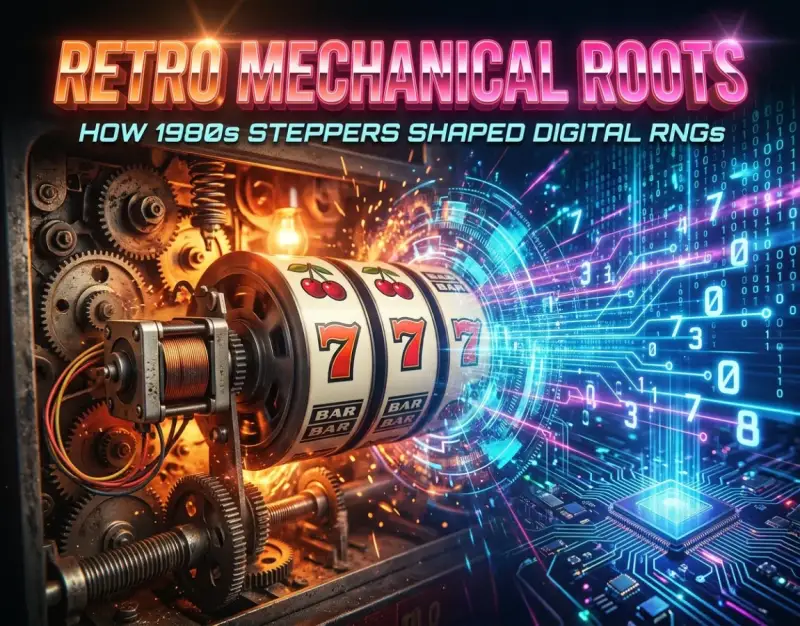
Step onto any contemporary casino floor—or open a cutting-edge online slot portal—and you will be instantly enveloped by a dazzling cacophony of high-definition displays, cascading animations, and complex multi-tiered bonus rounds. Yet, beneath this veneer of modern digital wizardry lies an engineering heritage forged decades ago. The blueprint for today's hyper-advanced algorithmic reels was drawn not in Silicon Valley software laboratories, but in the gritty, electromechanical workshops of the late 1970s and 1980s. This golden era of arcade and casino engineering birthed the classic mechanical stepper, a device that permanently altered the trajectory of gambling technology.
Understanding this lineage is more than a nostalgic exercise for retro enthusiasts; it is an analytical necessity for anyone looking to master the mathematics of modern gaming. When engineers transitioned from physical hardware to software-driven pseudo-randomness, they did not abandon the principles of the past. Instead, they digitized them. Concepts like virtual stops, weightings, and hit frequencies—staples of slot history—were designed to mimic and expand upon the physical constraints of heavy metal reels, optical sensors, and stepper motors. By examining how 1980s steppers bridged the gap between pure chance and calculated math, we gain unprecedented insight into how modern digital RNGs operate under the hood.
For players and industry observers alike, tracing this evolution illuminates why certain game designs endure while others fade into obscurity. Whether you are analyzing variance boosters or exploring The Hidden Psychology of Near-Misses: Why Your Brain Craves Another Spin, the psychological triggers remain deeply rooted in early mechanical engineering. This comprehensive deep dive will deconstruct the anatomy of vintage machines, map out the technical transition to digital algorithms, and reveal how the ghosts of 1980s hardware continue to dictate the behavior of contemporary video slots.
Foundational Principles: The Anatomy of Mechanical Steppers
To fully grasp how modern random number generators evolved, one must first deconstruct the physical machinery that preceded them. Before computer chips dictated every spin, slot machines relied on intricate electromechanical assemblies. These systems transformed raw electrical currents into precise physical movements, creating an immersive sensory experience defined by the clunk of stopping reels and the flash of incandescent bulbs.
The Stepper Motor and Optical Encoding
The heart of the 1980s slot machine was the stepper motor—a brushless DC electric motor that divides a full rotation into a number of equal steps. Unlike standard motors that spin continuously, stepper motors can be commanded to move and hold at precise angular positions. This technological leap allowed manufacturers to program exact stopping points for each reel.
To ensure the internal computer knew precisely where a reel had stopped, manufacturers integrated optical encoder disks attached directly to the motor shaft. These disks featured precise patterns of slotted cutouts. As the disk rotated, an infrared light beam passed through the slots to a phototransistor, generating electrical pulses that translated motor rotation into exact reel symbol positions. This closed-loop feedback mechanism guaranteed that physical reality matched digital intent.
Physical Constraints and the Birth of Virtual Stops
Early mechanical reels presented a profound mathematical limitation: the physical dimensions of the reel strip. A standard mechanical reel typically featured 20 physical stops (symbols or blank spaces). Consequently, the maximum possible combination on a three-reel machine was $20 \times 20 \times 20$, yielding a meager 8,000 possible combinations. This severely restricted both the size of the top jackpots and the granular control over the house edge.
To overcome this, engineers invented the concept of "virtual stops." By mapping a larger software-based array of numbers (e.g., 64 or 128 positions) to the 20 physical symbols, manufacturers could weight rare symbols—like jackpot sevens—differently without adding physical weight or altering the reel strip. This brilliant workaround laid the direct foundation for the digital probability tables used in modern RNG slots today.
The Paradigm Shift: From Heavy Metal to Microchips
The transition from mechanical dominance to microchip supremacy in the late 20th century was not instantaneous. It was a calculated evolution driven by the demand for higher jackpots, enhanced security, and regulatory compliance. As microprocessors became cheaper and more reliable, game designers seized the opportunity to uncouple the visual reel from the underlying mathematics.
The Introduction of Bally's and IGT's Microprocessor Era
During the late 1970s and throughout the 1980s, industry pioneers like International Game Technology (IGT) revolutionized the market by introducing microprocessor-based slot machines. Machines like the IGT Model M series replaced electromechanical relays with solid-state circuit boards powered by early CPUs. These boards could execute complex mathematical subroutines in milliseconds.
This computational leap meant that the outcome of a game was no longer determined by the momentum of a spinning mechanical drum or the slippage of a mechanical brake. Instead, the CPU made the definitive outcome decision the exact microsecond the player pulled the handle or pressed the spin button. The physical reels simply spun to display a predetermined result, introducing a profound philosophical shift in how casino games were conceptualized.
Regulatory Standards and the Standardization of Randomness
With software controlling outcomes, regulatory bodies required absolute transparency and tamper-proof verification. This era gave rise to strict testing laboratories and cryptographic validation standards. Software code was burned into EPROMs (Erasable Programmable Read-Only Memory) chips, preventing unauthorized physical tampering.
These EPROMs housed the core lookup tables and pseudo-random number generation algorithms. Because the math was now locked in silicon, regulators could audit the code to verify that the theoretical return-to-player (RTP) matched the physical payout over millions of simulated spins. This institutionalization of RNG mathematics created the trusted digital ecosystem that modern online casinos rely on today.
Deconstructing the RNG: How Digital Replicates Physical
Modern online slots operate entirely in the digital realm, yet their underlying programming structures remain faithful descendants of 1980s stepper logic. Understanding how a modern Random Number Generator functions reveals a direct architectural lineage to the physical reel strips of the past.
The Mechanics of Pseudo-Random Number Generation (PRNG)
True randomness is exceptionally difficult to generate computationally. Therefore, modern RNGs utilize complex deterministic algorithms—specifically variations of the Mersenne Twister or cryptographically secure PRNGs—that produce a sequence of numbers possessing properties closely approximating true randomness.
The algorithm continuously cycles through a vast numerical sequence (often millions of numbers per second) using an initial "seed" value derived from system noise or high-resolution hardware timers. The exact microsecond a player triggers a spin, the algorithm captures the current integer in the sequence. This integer is then fed into a mathematical formula that maps it directly to a specific symbol position on each reel.
Translating Integers to Reel Positions
Just as 1980s mechanical steppers mapped a broad virtual stop array to a physical 20-stop reel strip, modern RNG software maps enormous numerical ranges to digital reel positions. For instance, a 5-reel modern video slot might feature reels with dozens of symbols each, resulting in billions of potential combinations.
To control variance and hit frequency, game mathematicians assign wider numerical ranges to common symbols (like low-paying card royals) and razor-thin ranges to rare symbols (like expanding wilds or scatters). This granular control allows developers to fine-tune game volatility, echoing the exact weighting techniques pioneered by engineers working with physical stepper drums decades prior.
The Evolution of Volatility and Payout Structures
One of the most profound impacts of the mechanical stepper era was the formalization of slot volatility. In early 3-reel games, volatility was rigidly dictated by physical strip design. Today, digital slots utilize sophisticated mathematical models that build upon these historical mechanics to create complex payout structures.
Balancing Hit Frequency and Top-Tier Jackpots
In a mechanical stepper machine, increasing the jackpot size required either adding physical reels—which mechanically bloated the machine footprint—or expanding the virtual stop table within the EPROM. Game designers quickly realized that players craved the psychological thrill of chasing massive, life-changing payouts, even if it meant enduring longer dry spells between winning spins.
This dynamic forced the formalization of "hit frequency"—the statistical percentage of spins that result in any payout. By adjusting virtual weighting, 1980s engineers could calibrate a machine to hit frequently with small baseline wins or rarely with massive payouts. Modern digital slots inherit this exact balancing act, utilizing advanced variance boosters similar to those discussed in explorations of The Secret Math of Mystery Symbols: Unpredictable Variance Boosters.
The Psychological Legacy of Mechanical Design
The physical constraints of 1980s steppers also birthed enduring psychological motifs. For example, the phenomenon of the "near miss"—where a jackpot symbol lands just one position above or below the payline—was initially a byproduct of limited physical stopping accuracy and deliberate symbol spacing.
Engineers quickly discovered that players viewed near-misses not as randomized failures, but as close calls that signaled a win was imminent. Modern digital RNGs meticulously program these exact visual patterns into software animations, ensuring that the psychological engagement forged by mechanical constraints remains a cornerstone of modern game design.
Real-World Case Studies: Vintage Engineering vs. Modern Algorithms
To appreciate the practical application of these historical concepts, examining concrete operational case studies from both eras provides invaluable clarity. The challenges faced by engineers in the 1980s directly inform how modern software architects solve contemporary design problems.
Case Study 1: The Mechanical Stepper Weighting Overhaul (1984)
In 1984, a major land-based casino manufacturer faced a severe player retention problem with a popular 3-reel mechanical stepper series. The game featured a fixed 22-stop physical reel with a linear payout schedule, resulting in a predictable and ultimately boring player experience. The retention metrics plummeted by 35% over six months.
The Solution: Engineers implemented one of the earliest widespread uses of EPROM-controlled virtual stops. By expanding the software stop table to 64 positions while retaining the 22 physical symbols, they artificially weighted the top jackpot symbol to appear once every 1,200 spins physically, while maintaining a generous hit frequency for smaller wins. This mechanical-digital hybrid revitalized the cabinet line, boosting coin-in revenue by 50% within weeks. The lesson established the blueprint for modern RTP and variance tuning.
Case Study 2: The Modern RNG Grid Transition
Fast-forward to the digital age, where game developers often transition classic 3-reel math models into complex grid-based or cluster-paying formats. A prominent studio attempted to convert a classic high-volatility stepper math model into an asymmetric cascading grid slot.
The Failure: Initially, developers applied direct linear probability mapping without accounting for the cascading mechanic. The game suffered from wild mathematical imbalances, resulting in infinite loops of low-value wins and catastrophic bankroll drainage for players.
The Correction: Drawing on historical stepper weighting principles, the studio implemented a tiered pseudo-random number generation matrix that compartmentalized base spins from cascading events. This mirrored the old separation between physical reel momentum and core EPROM logic. Understanding how modern grid mechanics demand specialized financial management is further detailed in strategic breakdowns like Decoding Cluster Pays: Why Modern Grid Slots Demand a Total Bankroll Rewrite.
Critical Mistakes in Slot Design and Mathematical Implementation
Whether examining historical mechanical errors or modern software bugs, failing to respect the fundamental principles of slot math and hardware architecture leads to catastrophic failures. Here are the top five mistakes practitioners and designers make when translating retro mechanics to digital platforms, along with their exact countermeasures.
-
Ignoring Physical Weighting Constraints in Digital Replicas
The Mistake: Developers attempting to recreate retro 3-reel steppers digitally sometimes assign flat, unweighted probabilities to each symbol, destroying the classic high-volatility feel.
The Countermeasure: Always implement a robust virtual stop array with heavily skewed weightings for high-value symbols to authentically replicate historical variance profiles. -
Flawed PRNG Seeding Implementation
The Mistake: Utilizing predictable or static system timestamps for RNG seeding, leaving the software vulnerable to pattern exploitation.
The Countermeasure: Utilize cryptographically secure pseudo-random number generators backed by hardware-level entropy sources and continuous background re-seeding. -
Mismanaging Hit Frequency Versus Payout Ceiling
The Mistake: Designing a modern game with high hit frequencies that simultaneously promises massive top-tier jackpots without balancing the underlying mathematical hold.
The Countermeasure: Conduct rigorous Monte Carlo simulations running billions of test spins to ensure theoretical RTP aligns with mathematical tolerances before deployment. -
Overcomplicating the Visual-to-Math Translation
The Mistake: Allowing complex visual animations and bonus triggers to obscure the core RNG decision, leading to player distrust and regulatory friction.
The Countermeasure: Maintain absolute separation between the core RNG math determination (which occurs instantly) and the entertainment-focused animation layer. -
Neglecting Historical Player Psychology
The Mistake: Eradicating classic mechanical tropes like near-misses or deliberate symbol clustering in the name of pure, unadulterated mathematical randomness.
The Countermeasure: Intentionally design visual cadence and symbol placement to honor the psychological engagement principles established during the mechanical stepper era.
Comprehensive Comparison: Mechanical Steppers vs. Modern Digital RNGs
To clearly delineate how hardware-based engineering evolved into software architecture, the following comprehensive comparison table highlights the core metrics, mechanics, and operational differences between 1980s mechanical steppers and modern digital RNG slots.
| Feature / Metric | 1980s Mechanical Steppers | Modern Digital RNG Slots |
|---|---|---|
| Core Determination Engine | Stepper motors, optical sensors, and physical reel momentum. | Cryptographic PRNG algorithms executed on microprocessors. |
| Symbol Capacity & Stops | Limited by physical strip size (typically 20 to 22 physical stops). | Infinite virtual stops mapped via software arrays and databases. |
| Volatility & Variance | Rigidly fixed by physical reel weighting and strip configuration. | Dynamically tunable via complex mathematical weighting tables. |
| Auditing & Compliance | Physical inspection of EPROM chips and mechanical gear assemblies. | Rigorous digital source code analysis and million-spin simulation testing. |
| Player Psychology Impact | Pioneered the physical near-miss and tactile mechanical feedback. | Digitally simulates psychological triggers through advanced audiovisuals. |
Frequently Asked Questions
Did 1980s slot machines actually use random number generators?
Yes, but not in the way modern software does. Late 1980s machines utilized microprocessors running early pseudo-random number generation routines stored on EPROM chips. However, the software worked in tandem with physical stepper motors and optical encoders. The computer made the mathematical determination the moment the player spun, but the mechanical hardware physically enacted the result.
How did virtual stops change the slot industry?
Virtual stops solved the physical limitation of reel strip size. In mechanical machines, you could only fit a limited number of symbols on a physical reel, capping jackpot odds and payout variety. By mapping a larger software-based array of numbers to those physical symbols, manufacturers could offer massive million-dollar jackpots while maintaining precise control over the house edge.
Are modern online slots just digital copies of old mechanical machines?
While modern video slots feature advanced features like cascading reels, expanding wilds, and multi-layered bonus rounds, their underlying mathematical DNA is directly inherited from 1980s steppers. Concepts such as RTP, hit frequency, virtual weighting, and variance tuning were all standardized during the transition from pure mechanics to microchip technology.
Why do modern games still mimic the "near-miss" effect?
The near-miss effect—where a jackpot symbol lands just one position off the payline—was originally a natural byproduct of physical reel stopping mechanics and symbol spacing. Psychologists and game designers quickly realized that players interpreted near-misses as close calls rather than standard losses, driving engagement. Modern RNGs intentionally program these visual patterns into software animations to replicate that historical thrill.
How do testing laboratories verify that modern RNG slots are fair?
Independent testing laboratories (such as eCOGRA, GLI, and BMM Testlabs) audit the source code of digital slot games. They verify the integrity of the PRNG algorithm, inspect the EPROM or server-side code, and run massive statistical simulations—often exceeding 100 million test spins—to ensure that the theoretical return-to-player percentage matches regulatory standards over the long term.
Strategic Roadmap & Final Takeaway
The journey from the heavy metal gears of 1980s mechanical steppers to the weightless, cloud-based algorithms of modern digital RNGs represents one of the most fascinating engineering evolutions in entertainment history. What began as an effort to overcome physical reel constraints blossomed into a sophisticated science of probability, human psychology, and computational mathematics.
As we look ahead to the next two to five years, the industry is poised for another seismic shift. Emerging technologies such as blockchain-verified provably fair algorithms, immersive virtual reality (VR) casino floors, and artificial intelligence-driven dynamic volatility will continue to push boundaries. Yet, just as today's digital slots rely on the foundational math of 1980s steppers, future innovations will inevitably anchor themselves to these enduring principles. For players, developers, and industry analysts alike, mastering the mechanical roots of slot history remains the ultimate key to decoding the future of digital gaming.
Be the first to share a gentle reflection on this story.